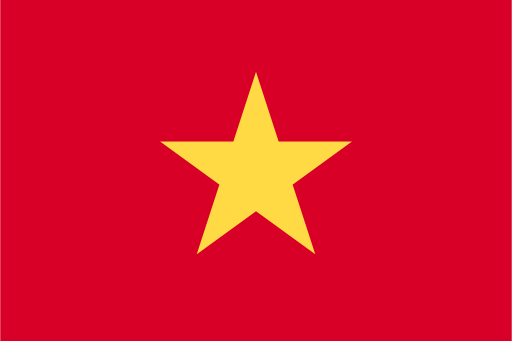
Vietnam
A one-party state with a market-oriented economy that is deeply integrated into global trade.
One-party socialist republicAsia
How close are you to Vietnam?
Take the test and your match with Vietnam shows up here. It is worked out in your browser and never sent anywhere.
Is Vietnam a democracy?
The sources below describe institutions and, where available, independent democracy ratings. Written rules and political practice are different kinds of evidence.
Vietnam’s political and economic arrangements need separate readings. Freedom House’s 2026 report describes one-party rule and restrictions on dissent; the 2013 constitutional text also recognises a market economy.
Vietnam at a glance
- State structure
- Article 4 of the 2013 text assigns a leading role in state and society to the Communist Party. [Vietnam Law & Legal Forum]
- Legislature
- Article 69 identifies the National Assembly as the highest representative body and organ of state power. [Vietnam Law & Legal Forum]
- Constitution
- The cited English translation is the 2013 text and predates later constitutional amendments. [Vietnam Law & Legal Forum]
What is the political profile of Vietnam?
Estimated scores on all twelve axes, with the strongest leanings first.
Strongest leanings
Leans very strongly toward Unitary
90% toward Unitary
Leans very strongly toward Autocratic
90% toward Autocratic
Leans very strongly toward Security
88% toward Security
Why Vietnam scores this way
The documented directions are explained below, including axes outside the three strongest leanings. Sources do not determine an exact numerical score, and axes without a cited explanation remain undocumented editorial estimates.
- Federal vs Unitary
Article 2 of the cited 2013 text treats state power as unified and allocates its exercise among state bodies. This supports the unitary direction; it is not a claim that local administration has no powers. The cited edition predates later constitutional amendments. [Constitute Project]
- Democratic vs Autocratic
The party’s leading role and restrictions on opposition support the autocratic-side interpretation, rather than treating legislative elections alone as proof of competition. [Vietnam Law & Legal Forum, Freedom House]
- Security vs Freedom
Freedom House’s 2026 report describes tight restrictions on expression and civil society, and gives 1 out of 4 for expressing personal views without fear of surveillance or retaliation. This supports a security-side interpretation; that external assessment does not convert directly into our axis percentage. [Freedom House]
- Collectivize vs Privatize
Article 51 recognises multiple ownership forms and a leading state sector. Public ownership and private enterprise therefore cannot be reduced to an all-or-nothing choice. [Vietnam Law & Legal Forum]
- Planned vs Laissez-faire
The same market-economy provision makes “socialist” an inadequate substitute for measuring actual planning and regulation. Our economic scores remain editorial estimates. [Vietnam Law & Legal Forum]
5 of 12 axes have a cited explanation on this page. Sources support particular claims and directions; the exact percentages do not have a validated numerical rubric.
Governmental
Diplomatic
Economic
Societal
Editorial estimates of the political system and mainstream politics of Vietnam, for comparison and discussion. They are not survey results or the views of every citizen.
Which countries are most similar to Vietnam?
Ranked by how closely their estimated profile matches this one.
Which ideologies fit Vietnam best?
Ideologies whose typical profile is closest. No country follows a single ideology, so read these as comparisons, not labels.
Where do these scores come from?
They are editorial estimates of long-run patterns in a country's political system and mainstream politics. They are made for comparison and discussion, so treat them as a starting point rather than a measurement.
How profiles and matches workSources
- Vietnam Law & Legal Forum: 2013 Constitution: English translation, arts. 4, 51 and 69; predates later amendments
- Freedom House: Freedom in the World 2026: Vietnam (annual context, principally 2025)
- Constitute Project: Vietnam Constitution, 2013 text, article 2; predates later amendments
Last reviewed October 26, 2026. Ratings are updated every year, so check the source for the latest edition.
Vietnam on the 12 axes: frequently asked questions
Something else on your mind? Get in touch
Where do you stand next to Vietnam?
The test scores you on all twelve axes and ranks every country by how well it matches you.