Skip to content
12 Axes Test

Progressive vs Traditional

The Progressive vs Traditional axis asks how fast and how far society should change its norms: reform them to match new ideas of equality and freedom, or preserve inherited ways of life.

Societal domain0% Progressive ⟷ 100% Traditional
Progressive

Society should keep changing and reforming, questioning old customs and extending rights and equality.

vs
Traditional

Established customs, institutions and values deserve to be preserved, and change should be slow and careful.

0% (Progressive)50% Neutral100% (Traditional)

The question this axis asks: Should society move on from old customs, or protect them?

Where do you stand?

Statement 1 of 3

Society should move on from old customs, even when many people are attached to them.

Nothing is sent anywhere.

What is Progressive vs Traditional?

The question this axis asks

Should society move on from old customs, or protect them?

This axis covers social and cultural issues: family and gender roles, marriage laws, ideas of equality and anti-discrimination policy, the weight given to long-standing customs and the pace of social change. It asks about attitudes toward change rather than any single policy.

People on the Progressive side usually argue that many customs are unfair and that societies improve by reforming them, guided by reason and evidence. People on the Traditional side usually argue that customs hold accumulated wisdom, provide stability and belonging, and that rapid change can do harm.

What does each side believe?

Neither side is better or worse. They are different answers to the same question.

What does Progressive mean?

Society should keep changing and reforming, questioning old customs and extending rights and equality.

Typical positions

  • Old customs should be updated when they are unfair
  • Same-sex couples should have equal legal rights
  • Affirmative action can correct past discrimination
  • Many gender roles are social constructs
  • Enlightenment ideals should guide society

What does Traditional mean?

Established customs, institutions and values deserve to be preserved, and change should be slow and careful.

Typical positions

  • Long-standing customs deserve respect
  • The traditional family is a strong foundation
  • Society has changed too fast
  • Traditions should be protected from dilution
  • Rapid change often causes more problems than it solves

What does your Progressive vs Traditional score mean?

Scores run from 0% to 100% toward Traditional. Here is how to read them.

ScoreWhat it suggests
0–15%Very strongly Progressive
16–30%Strongly Progressive
31–43%Leaning Progressive
44–56%Near the middle
57–69%Leaning Traditional
70–84%Strongly Traditional
85–100%Very strongly Traditional

A middle score suggests you support change on some issues and caution on others.

How does Progressive vs Traditional play out in the real world?

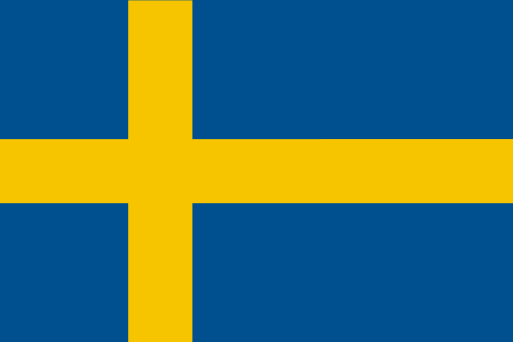
Surveys of values often place countries such as the Netherlands and Sweden among the most socially progressive and countries such as Nigeria and Pakistan among the most traditional. Within countries, attitudes often differ by age, region and religion. Estimated profiles of countries and ideologies at each end of this axis.

These are editorial estimates for discussion, not rankings of quality.

What do people get wrong about Progressive vs Traditional?

  • Progressive and Traditional are about attitudes to social change, not about being left or right on economics.
  • Many people are progressive on some issues and traditional on others, which is why the test asks several questions.

Frequently asked questions about Progressive vs Traditional

Progressive values favor social change, reform and the extension of equal rights. Traditional values favor continuity, established customs and institutions, and gradual change.

Not necessarily. Progressive in this test concerns social change. Economic left and right are measured on other axes.

The Enlightenment’s emphasis on reason and individual rights is often cited as a root of progressive thinking, while critics from the Traditional side stress the value of inherited customs.

Something else on your mind? Get in touch

Ready for all twelve?

Three statements show one axis. The full test scores every axis and finds your closest countries and ideologies.