Skip to content
12 Axes Test

Irreligious vs Religious

The Irreligious vs Religious axis asks what role religion should play in public life: separate from the state, or woven into law, education and politics.

Societal domain0% Irreligious ⟷ 100% Religious
Irreligious

Religion should be kept out of law and government, which should rest on reason and secular principles.

vs
Religious

Religion should shape law, education and public life, as a source of moral authority.

0% (Irreligious)50% Neutral100% (Religious)

The question this axis asks: Should law and government be secular, or should they reflect religious teaching?

Where do you stand?

Statement 1 of 3

Laws should be based on reason and evidence, not on religious teachings.

Nothing is sent anywhere.

What is Irreligious vs Religious?

The question this axis asks

Should law and government be secular, or should they reflect religious teaching?

This axis is about the relationship between religion and the state: religious law, religion in schools, blasphemy rules, state religions and the political influence of religious leaders. It does not measure personal belief. A devout person can favor a secular state, and a non-believer can favor tradition in public life.

People on the Irreligious side usually argue that a secular state treats all citizens equally and protects freedom of conscience. People on the Religious side usually argue that religion is the basis of morality and community and that law should reflect it.

What does each side believe?

Neither side is better or worse. They are different answers to the same question.

What does Irreligious mean?

Religion should be kept out of law and government, which should rest on reason and secular principles.

Typical positions

  • Laws should rest on reason and evidence
  • Religion is a private matter
  • Public schools should be secular
  • Religious leaders should have no special political influence
  • Insulting a religion should not be a crime
What does Religious mean?

Religion should shape law, education and public life, as a source of moral authority.

Typical positions

  • Laws should reflect a country’s main religious teachings
  • Religion is the best foundation for morality
  • Religious education belongs in public schools
  • Religious law can be a foundation of the legal system
  • Some would favor religious leaders governing

What does your Irreligious vs Religious score mean?

Scores run from 0% to 100% toward Religious. Here is how to read them.

ScoreWhat it suggests
0–15%Very strongly Irreligious
16–30%Strongly Irreligious
31–43%Leaning Irreligious
44–56%Near the middle
57–69%Leaning Religious
70–84%Strongly Religious
85–100%Very strongly Religious

A middle score suggests you value religious freedom and heritage but do not want religion to dictate law.

How does Irreligious vs Religious play out in the real world?

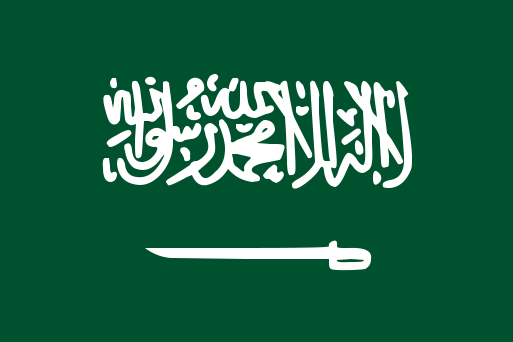
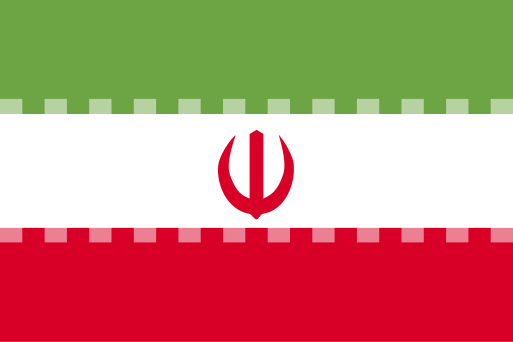
France and Mexico have long traditions of strict secularism, the United States separates church and state yet is highly religious, the United Kingdom and Denmark have established churches, and Iran and Saudi Arabia ground their legal systems in Islamic law. Estimated profiles of countries and ideologies at each end of this axis.

These are editorial estimates for discussion, not rankings of quality.

What do people get wrong about Irreligious vs Religious?

  • Your score on this axis is not a test of your faith. Many religious people prefer a secular state.
  • Irreligious here means separating religion from government. It does not mean hostility toward religion.

Frequently asked questions about Irreligious vs Religious

It describes the preference to keep religion out of law and government, on the basis that the state should be secular. It does not mean opposing religion.

The principle that government and public institutions should be separate from religious authority and neutral between beliefs.

A system in which religious leaders or religious law hold ultimate political authority.

Something else on your mind? Get in touch

Ready for all twelve?

Three statements show one axis. The full test scores every axis and finds your closest countries and ideologies.