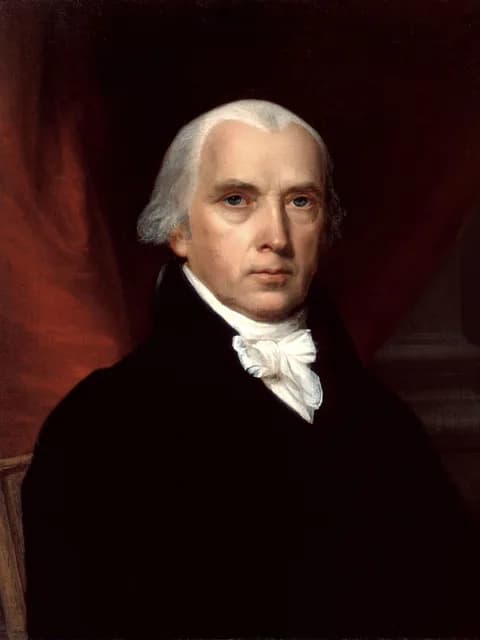
Fourth US president
James Madison’s political views
Principal drafter of the US Constitution and the Bill of Rights, and the fourth president, who argued that dividing and balancing power protects liberty.
- Presidency
- 4th, 1809–1817
- Party
- Democratic-Republican
- Lived
- 1751–1836
- Scored on
- 9 of 12 axes
Strongest documented leanings
- Irreligious85%
- Freedom80%
- Democratic78%
Where Madison stood on the twelve axes
Each bar is one axis, between its two poles. Only axes with a documented position are scored; the others are shown as faint stubs on the icon and listed below, never as neutral.
Based on the Federalist Papers and his Memorial and Remonstrance Against Religious Assessments.
- Federal vs UnitaryFederal 55%FederalUnitary
Federalist No. 39 calls the new government neither wholly federal nor wholly national.
- Democratic vs AutocraticDemocratic 78%DemocraticAutocratic
Federalist Nos. 10 and 51 defend a representative republic with separated powers, so that ambition checks ambition.
- Security vs FreedomFreedom 80%SecurityFreedom
Drafted the Bill of Rights, and his 1800 Virginia Report condemned the Sedition Act.
- Militarist vs PacifistPacifist 70%MilitaristPacifist
Wrote in 1795 that of all the enemies to public liberty war is perhaps the most to be dreaded.
- Assimilationist vs MulticulturalistAssimilationist 70%AssimilationistMulticulturalist
Served as president of the American Colonization Society, which resettled freed slaves in Liberia, seeing it as a gradual way to end slavery.
- Collectivize vs PrivatizePrivatize 72%CollectivizePrivatize
Federalist No. 10 calls the protection of men’s unequal faculties for acquiring property the first object of government.
- Isolationism vs GlobalismIsolationism 60%IsolationismGlobalism
As president he signed the protective Tariff of 1816.
- Irreligious vs ReligiousIrreligious 85%IrreligiousReligious
The Memorial and Remonstrance of 1785 opposes any state support for religion.
- Progressive vs TraditionalProgressive 70%ProgressiveTraditional
Federalist No. 14 says Americans should not let a blind veneration for antiquity and custom overrule their own good sense.
No documented position, so not scored: Nationalism vs Internationalism, Planned vs Laissez-faire, and Acceleration vs Bioconservative.
What shaped the scores
Dated actions from the record. Each is tied to the axis it informs.
His Memorial and Remonstrance against Religious Assessments opposes Virginia’s plan to fund teachers of the Christian religion.
Irreligious vs Religious
Memorial and Remonstrance against Religious Assessments · National ArchivesFederalist No. 10 argues that a large republic can control the dangers of faction.
Collectivize vs Privatize
Federalist No. 10 · The Avalon ProjectHe introduces the amendments that become the Bill of Rights in the House of Representatives.
Security vs Freedom
James Madison · WikipediaHe writes the Virginia Report of 1800, which defends Virginia’s resolutions against the Alien and Sedition Acts.
Security vs Freedom
Kentucky and Virginia Resolutions · WikipediaAs president he asks Congress for a declaration of war on Britain.
Militarist vs Pacifist
Presidency of James Madison · WikipediaIn one of his last acts as president he vetoes the Bonus Bill, arguing that the General Welfare Clause does not broadly authorise federal spending on internal improvements.
Federal vs Unitary
Presidency of James Madison · Wikipedia
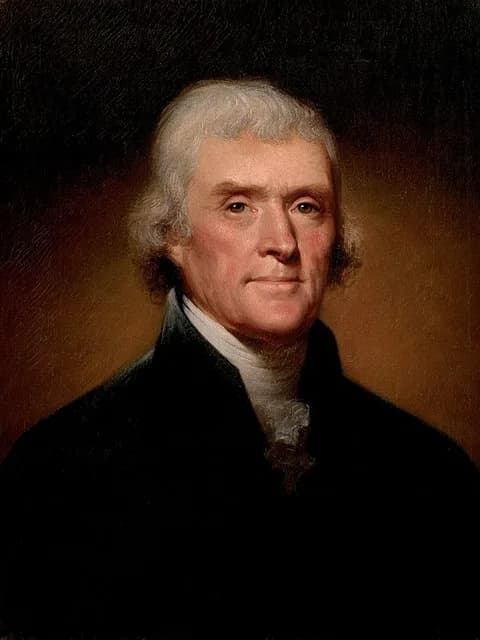
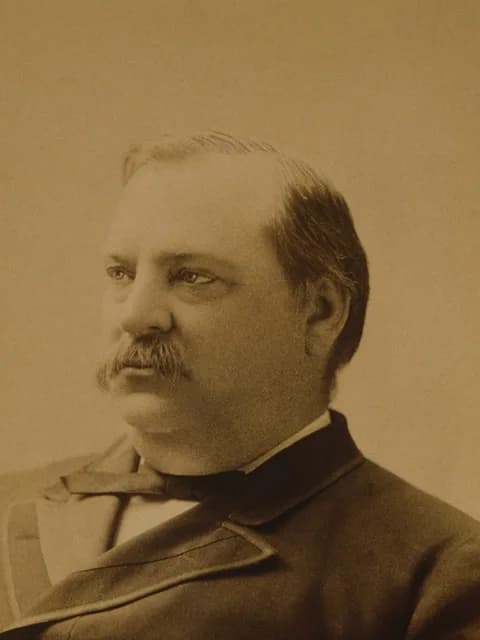
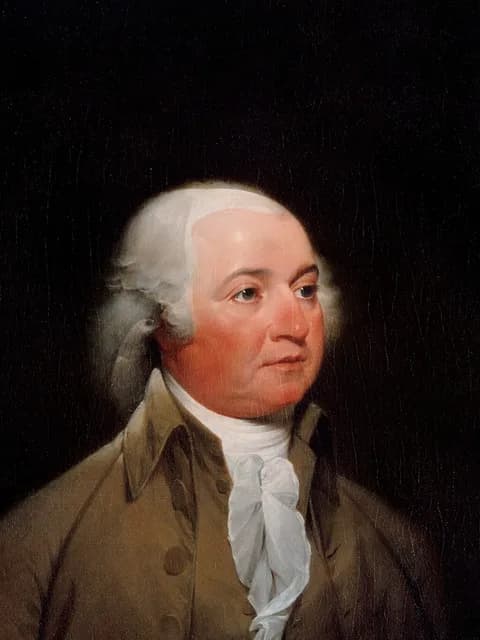
Madison compared with other presidents
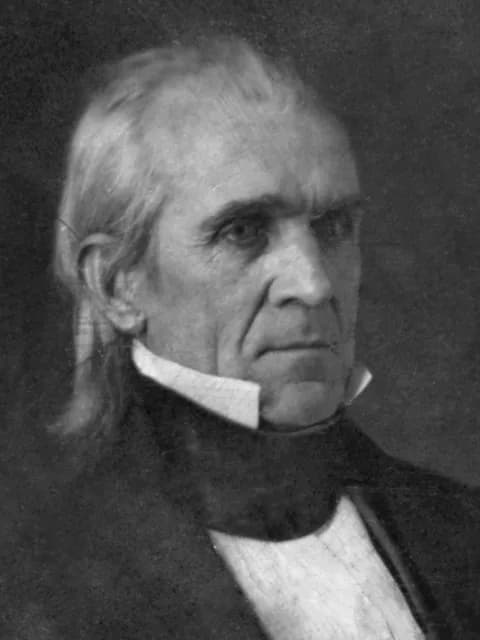
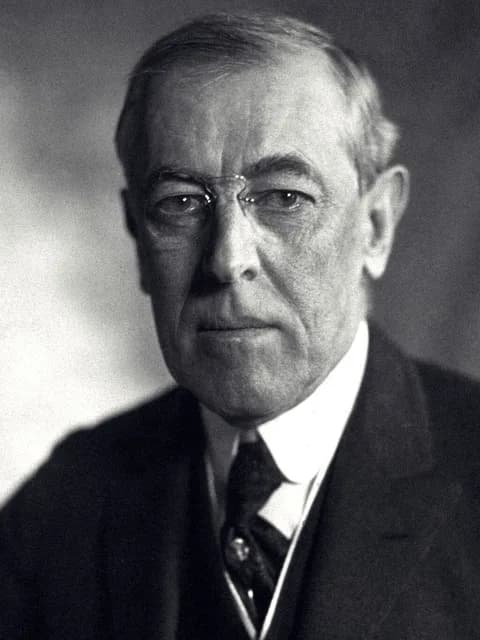
Measured on the axes both presidents are scored on, with the same rules as the quiz.

Questions about James Madison’s politics
Something else on your mind? Get in touch
Sources and credits
Main source: Federalist No. 10 · The Avalon Project
Portrait: John Vanderlyn, 1816 · Public domain
Scores are editorial estimates from the public record, not measurements. A place on this site is not praise.
Keep exploring
- All presidents in the quizTake the test and see which president you are closest to.
- Thomas JeffersonThe president before Madison in our list.
- Andrew JacksonThe president after Madison in our list.
- United StatesWhere the United States sits on the twelve axes.
- MethodologyHow the axes, the scoring and the matching work.
How close are you to Madison?
Take the test and see how your twelve scores compare, axis by axis.